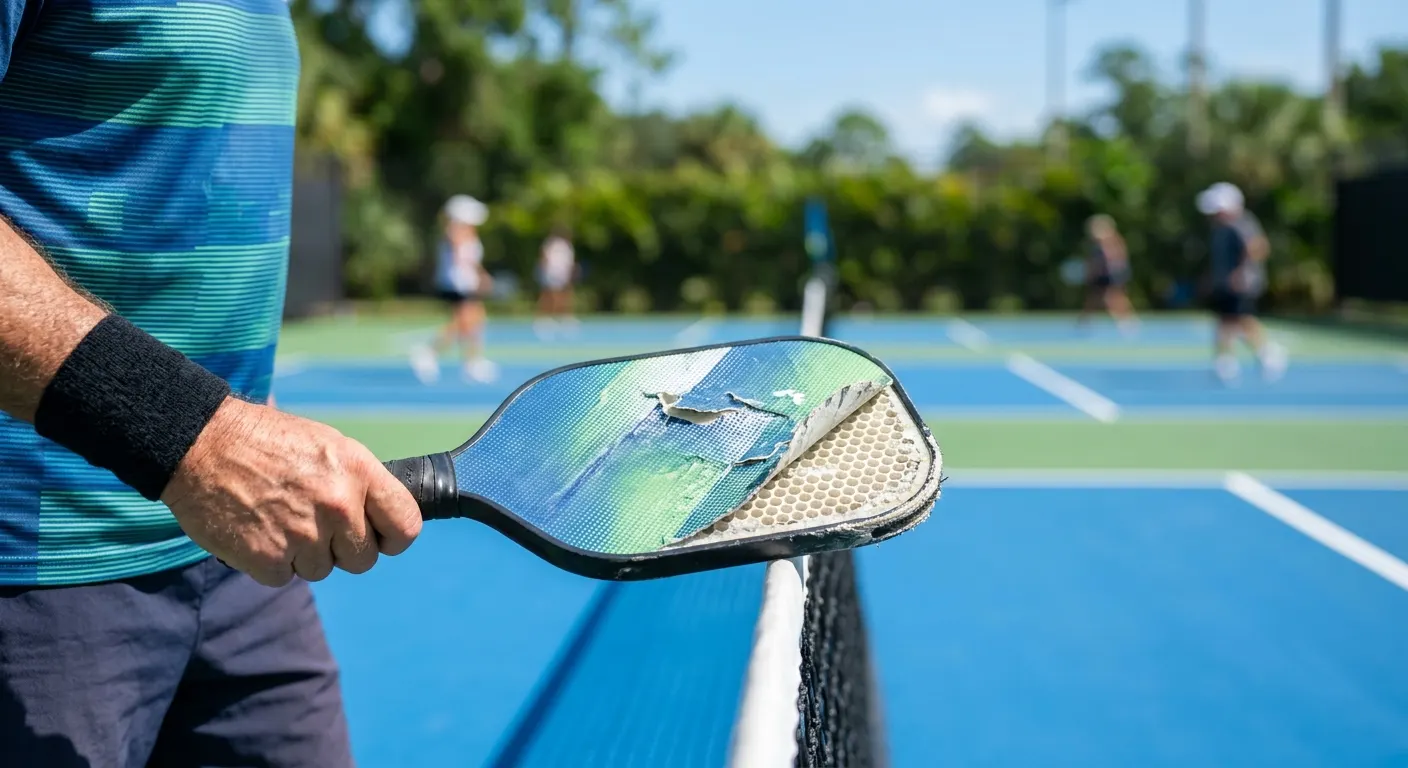
If you have heard players at open play talk about a paddle being 'hot' or 'delam,' they are talking about delamination, the single most discussed paddle problem of the current era. A delaminated paddle plays faster than it should, often sounds different on contact, and in sanctioned competition it is illegal. The frustrating part is that delamination can develop in a paddle that was perfectly legal when you bought it. This guide explains what delamination is in plain language, why USA Pickleball removes hot paddles from its approved list, how to check your own paddle for the warning signs, and how to confirm your exact model is currently legal before you step into a tournament.
Quick answer
Delamination is when a paddle's face sheet separates from its core, creating an air pocket that acts like a trampoline and adds illegal ball speed. USAP delists paddles that test hot on PBCoR or delaminate in the field. Listen for a hollow rattle or buzzy contact, watch for face bubbling, and verify your exact model at equipment.usapickleball.org before competing.
This guide contains affiliate links. DinkRun may earn a commission at no cost to you.
What delamination actually is
A modern pickleball paddle is built from a thin carbon fiber or fiberglass face sheet bonded to a honeycomb core. When that bond holds, the face flexes a tiny, controlled amount on contact and returns a predictable amount of energy to the ball. Delamination happens when the face sheet separates from the core and an air pocket forms underneath. That pocket behaves like a spring: on contact the face deflects much further than it should, snaps back, and launches the ball faster than your swing alone would produce.
Players call this a 'hot' paddle because the ball comes off the face with extra pace that the swing did not generate. It is most common in thermoformed paddles, where heat and pressure fuse the face and sidewalls, because some early production runs of that construction had bonding that was not fully dialed in. A paddle can pass testing when new and then delaminate weeks or months later in the field as repeated impacts work the bond loose.
Delamination is not the same as core crush. Core crush is the gradual softening of a honeycomb core as repeated impacts compress the cells, and it tends to make a paddle play deader over time. Delamination does the opposite: it makes the paddle livelier and faster in an illegal way. Both are durability problems, but only delamination produces the hot, trampoline-like behavior that gets a paddle delisted.
Why USAP delists hot paddles
USA Pickleball introduced the PBCoR (Paddle/Ball Coefficient of Restitution) testing standard in late 2024, with enforcement beginning July 1, 2025. PBCoR measures how much energy a paddle returns to the ball on contact. A paddle that returns too much energy gives a player a ball-speed advantage that comes from the equipment rather than from skill or swing speed, and that is what the standard is designed to prevent. Paddles that test above the threshold are removed from the approved list.
Delamination is one of the main ways a paddle ends up testing hot. Because a delaminated face flexes and snaps back further than a properly bonded one, it inflates the energy return and pushes the paddle over the PBCoR limit. This is why USAP has periodically removed paddles that had been approved for months: the in-field, delaminated performance diverged from the performance of the same model when it was tested new and legal.
For the catalog paddles, the established premium models from Selkirk, JOOLA, Paddletek, and CRBN have maintained their approval status through the current testing cycle, and none of them were among the 2025 removals. That does not make any paddle immune to developing delamination through use, which is why the warning signs below matter for every paddle, not just the ones that made headlines. If you compete, verify the JOOLA Ben Johns Hyperion CFS 16mm or Selkirk LUXX Control Air S2 you own by its exact model name rather than trusting the brand reputation alone.
pickleball paddles
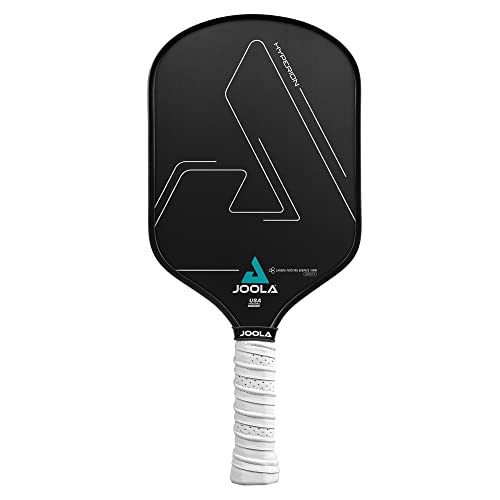
JOOLA Ben Johns Hyperion CFS 16mm
The paddle that Ben Johns helped develop for all-court play. A carbon fiber surface generates reliable spin while the 16mm core balances soft-game control with enough power for attacking fourth shots. Elongated shape favors players with a tennis background.

pickleball paddles
Selkirk LUXX Control Air S2
A 20mm Thikset honeycomb core paired with a Florek Blended Carbon Fiber face produces one of the softest, most responsive dinking experiences on the market. At 8.1 to 8.5 oz and with a 4.5-inch handle, it is built for kitchen-dominant players who value touch over raw power.
How to check your paddle for delamination
The fastest field check is sound. Tap the face across different spots with a knuckle or flick it with a fingernail. A solid, consistent thock across the whole face is the sound of a healthy bond. A hollow, rattly, or buzzy sound in one area, especially near the top of the face, is the classic signature of a separated section. Many players first notice the change during play: the paddle suddenly sounds different on contact and the ball jumps off faster than it used to.
Look at the face under good light at a shallow angle. Surface bubbling, a slightly raised or rippled patch, or a visible lump where the face is lifting off the core are all visible delamination signs. You can also press firmly across the face with your thumb and feel for any spot that gives or clicks differently than the rest. A healthy paddle feels uniform and rigid everywhere; a delaminated one has a soft or springy zone.
Be honest with yourself about a paddle that suddenly feels too good. A jump in your put-away speed that you did not earn through practice, paired with a new sound, is a reason to test the paddle rather than enjoy the free power. If you are upgrading away from a suspect paddle, a known-good control model like the Paddletek Tempest Wave Pro-C or an all-court CRBN 2X 16mm Power Series gives you a clean, legal baseline to play from.
pickleball paddles
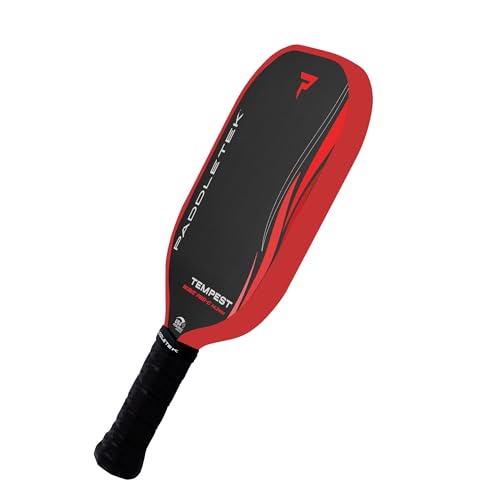
Paddletek Tempest Wave Pro-C
A USA-manufactured 14.3mm carbon fiber paddle built around Paddletek's Smart Response Technology polymer core. Weighing 7.6 to 8.0 oz, the Tempest Wave Pro-C is the control-focused choice in the Paddletek lineup, favored by players who prioritize placement over pace.

pickleball paddles
CRBN 2X 16mm Power Series
A 16mm thermoformed carbon fiber paddle with injected foam edge walls, an 8-inch-wide face for an expanded sweet spot, and CRBN's TruFoam construction. The 2X is the wider-body version of CRBN's power line and the brand's most forgiving model for intermediate players.
Confirming your paddle is still legal
The only authoritative source for current approval status is the official USA Pickleball equipment list at equipment.usapickleball.org. Search for your exact model by manufacturer name, including any suffix such as a thickness label or configuration code, because some paddles exist in multiple versions and only certain ones get removed. Do not rely on the approval stamp printed on the paddle face. That stamp reflects the status at the time of manufacture, and a paddle can be stamped approved and later delisted.
Run this check before any sanctioned tournament or league that enforces the USAP standard, not just once when you buy. The list is a living document that changes as new testing rounds complete. For casual open play, none of this matters: a delaminated or delisted paddle is still legal for recreational sessions where no one is enforcing the equipment list. The legality concern applies only to organized events that follow USAP rules.
If you confirm your paddle is hot or delisted and you compete, you need a replacement from the current approved list. Store your next paddle well to slow the structural wear that leads to delamination: keep it out of hot car interiors, which can weaken the adhesive bond in thermoformed builds, and use a Selkirk Paddle Cover to protect the face from the abrasion and edge knocks that work a bond loose over time.
court training accessories
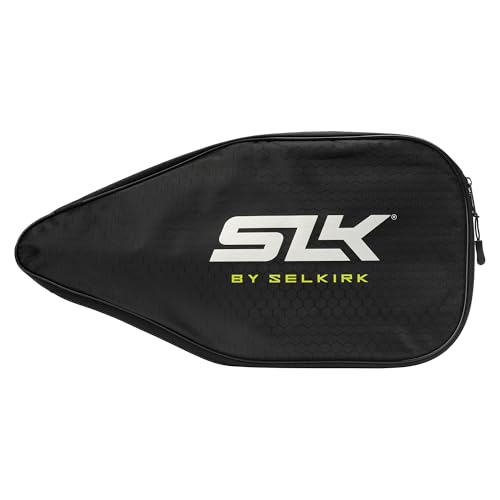
Selkirk Paddle Cover
A neoprene paddle cover that wraps individual paddles for protection during transport. Prevents edge guard damage and face scratches from paddles contacting each other inside a bag, and protects against humidity damage to polymer cores during storage.
pickleball paddles
JOOLA Ben Johns Hyperion CFS 16mm
The paddle that Ben Johns helped develop for all-court play. A carbon fiber surface generates reliable spin while the 16mm core balances soft-game control with enough power for attacking fourth shots. Elongated shape favors players with a tennis background.
pickleball paddles
Selkirk LUXX Control Air S2
A 20mm Thikset honeycomb core paired with a Florek Blended Carbon Fiber face produces one of the softest, most responsive dinking experiences on the market. At 8.1 to 8.5 oz and with a 4.5-inch handle, it is built for kitchen-dominant players who value touch over raw power.
pickleball paddles
Paddletek Tempest Wave Pro-C
A USA-manufactured 14.3mm carbon fiber paddle built around Paddletek's Smart Response Technology polymer core. Weighing 7.6 to 8.0 oz, the Tempest Wave Pro-C is the control-focused choice in the Paddletek lineup, favored by players who prioritize placement over pace.
pickleball paddles
CRBN 2X 16mm Power Series
A 16mm thermoformed carbon fiber paddle with injected foam edge walls, an 8-inch-wide face for an expanded sweet spot, and CRBN's TruFoam construction. The 2X is the wider-body version of CRBN's power line and the brand's most forgiving model for intermediate players.
court training accessories
Selkirk Paddle Cover
A neoprene paddle cover that wraps individual paddles for protection during transport. Prevents edge guard damage and face scratches from paddles contacting each other inside a bag, and protects against humidity damage to polymer cores during storage.
FAQ
Frequently asked questions
How can I tell if my paddle is delaminated?+
Listen and look. Tap the face in several spots: a healthy paddle gives a solid, consistent thock everywhere, while a delaminated section sounds hollow, rattly, or buzzy, often near the top of the face. Inspect under raking light for bubbling, ripples, or a raised patch where the face is lifting. A sudden jump in ball speed paired with a new contact sound is the most common first clue players notice during play.
Is a delaminated paddle illegal everywhere?+
No. A hot or delisted paddle is only a problem in sanctioned USAP tournaments and leagues that enforce the approved equipment list. For casual open play and most recreational sessions, you can use any paddle regardless of approval status, since no one is checking. The legality concern applies strictly to organized competition. If you only play recreationally, a delaminated paddle is a feel and fairness issue, not a rules violation.
How do I confirm my exact model is still approved?+
Check the official USA Pickleball equipment list at equipment.usapickleball.org and search your model by manufacturer name, including any thickness or configuration suffix. Different versions of the same paddle can have different statuses. Do not trust the approval stamp on the paddle, which only reflects the status when it was made. Run this check before each tournament, because the list updates as new testing rounds finish.