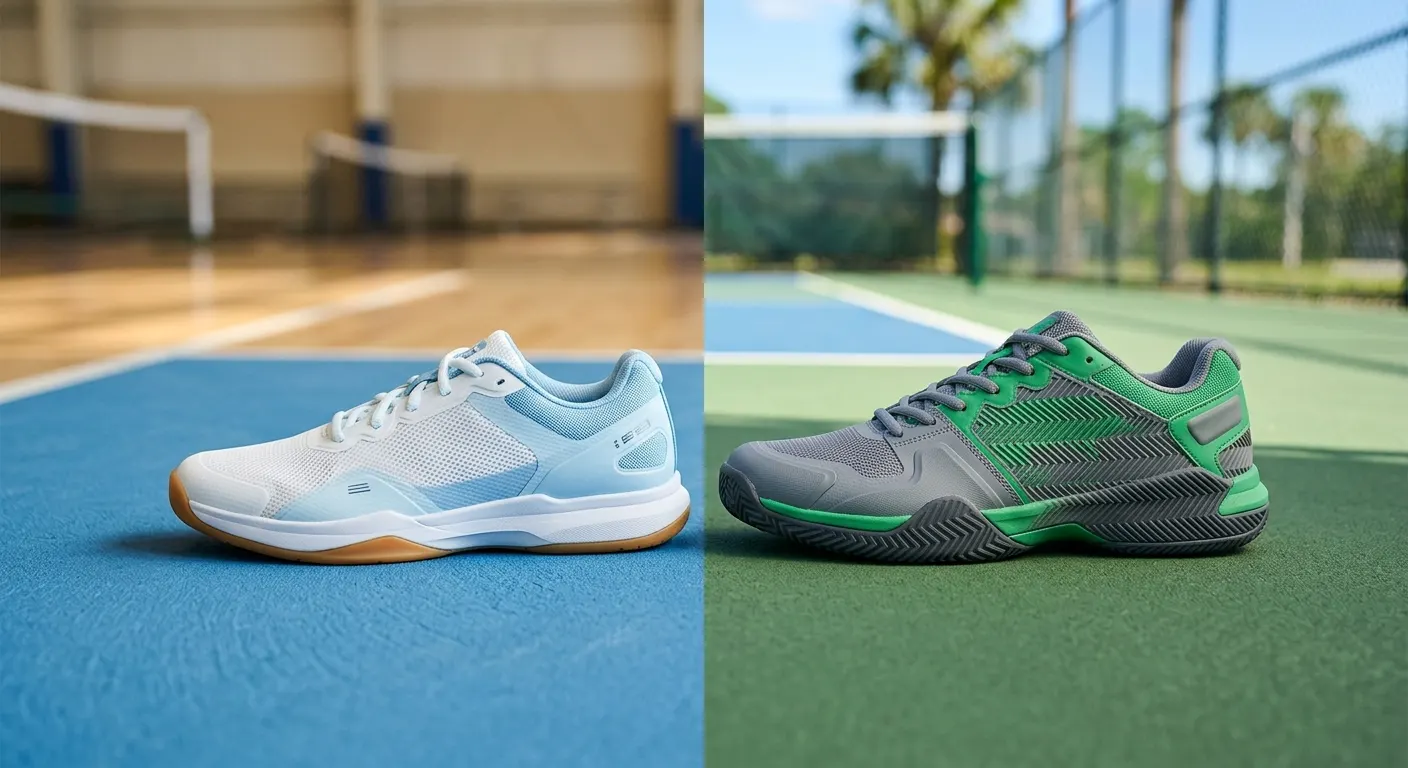
One of the most common questions from new pickleball players is whether the same shoes work indoors and outdoors. The short answer is that the surface changes what you should look for, and an outdoor court will destroy a soft indoor outsole in weeks while an indoor floor wants the grip and non-marking sole an outdoor shoe may not have. You do not always need two separate pairs, but you do need to understand the tradeoff so you buy the right shoe for where you actually play. This guide explains how indoor and outdoor pickleball shoes differ, what to prioritize for each surface, and which court shoes hold up.
Quick answer
Outdoor pickleball, played on concrete or asphalt, demands a durable abrasion-resistant outsole and more cushioning, which is why tougher tennis-style court shoes like the ASICS Gel-Resolution 9 last longest there. Indoor play on gym floors wants a grippier non-marking outsole and a lighter shoe. The same shoe can cover both if its outsole is durable and non-marking.
This guide contains affiliate links. DinkRun may earn a commission at no cost to you.
Why the surface changes the shoe
Pickleball is played on two very different surfaces, and they place opposite demands on a shoe. Outdoor courts are concrete or asphalt: abrasive, hard, and unforgiving. They chew through soft outsoles quickly and transmit more impact to your feet, so an outdoor shoe needs a tough, abrasion-resistant outsole and enough cushioning to absorb the pounding. Indoor courts are smooth wood or sport tile: far gentler on the outsole but slicker, so an indoor shoe needs an outsole compound and tread that grip a polished floor and leave no marks.
The two big variables are outsole durability and outsole grip, and they pull in different directions. An outdoor outsole is built tough first; an indoor outsole is built grippy and non-marking first. That is why a dedicated indoor shoe, with its softer gum-style sole, wears out fast on concrete, and why a heavy-duty outdoor shoe can feel less planted on a gym floor. Knowing which variable matters for your court is the whole decision.
What to look for in an outdoor shoe
For outdoor play, prioritize a durable outsole and lateral support, because that is what survives the surface and protects you on it. Tennis-style court shoes are built for exactly this: hard-court outsoles engineered to resist abrasion, plus the reinforced sides that handle the constant lateral cuts pickleball demands. The ASICS Gel-Resolution 9 is the standout here, a tennis-court shoe with the cushioning and outsole durability that hold up to repeated concrete sessions far better than a lightweight indoor design.
Cushioning matters more outdoors than in because hard surfaces send more shock up through your legs. The FILA Volley Zone Pickleball Shoe is another court-style option built for hard surfaces, with the stability features that keep your foot planted during quick direction changes. The common thread for outdoor shoes is that they treat durability and support as the priority, accepting a bit more weight in exchange for lasting on a surface that destroys flimsy soles.

pickleball shoes
ASICS Gel-Resolution 9
ASICS Gel-Resolution 9 is the court shoe that serious pickleball players reach for when durability and lateral support are the priorities. Dynawall technology locks the ankle in position during lateral cuts. A herringbone outsole grips both indoor and outdoor court surfaces.

pickleball shoes
FILA Volley Zone Pickleball Shoe
FILA's entry into the dedicated pickleball shoe market delivers a non-marking rubber outsole, a cushioned midsole, and reinforced medial support at a price that undercuts most competitors. The Volley Zone is the budget-value option for players who want a dedicated court shoe without the premium footwear cost.
What to look for in an indoor shoe
Indoors, prioritize grip and a non-marking outsole, with lighter weight as a bonus. A gym floor is slicker than concrete, so the outsole compound and tread pattern need to bite into a smooth surface for confident stops and starts, and the sole must be non-marking so you do not scuff the floor, which many facilities require. Because the surface is not abrasive, you can favor a lighter, quicker shoe without worrying about it wearing through.
A lighter court shoe such as the K-Swiss Express Light 2 or the Skechers Viper Court Pro suits indoor play well, offering quickness and a non-marking outsole for gym-floor grip. The lighter build helps you move and reduces fatigue over a long indoor session where you are not fighting wind or rough ground. Confirm the outsole is labeled non-marking before playing at any indoor facility, since that is often a house rule.

pickleball shoes
K-Swiss Express Light 2
K-Swiss brings their court-sport heritage from tennis into a shoe designed specifically for pickleball's movement patterns. SURGEBRACE ankle support, AOSTA 7.0 rubber outsole with court-specific traction zones, and available in a 2E wide fit for players who have struggled to find a comfortable court shoe.

pickleball shoes
Skechers Viper Court Pro
The best-selling dedicated pickleball shoe in the United States by unit volume. Goodyear rubber outsole, mesh upper with rubber toe guard, and Skechers' comfort midsole foam. The Viper Court Pro is the shoe that most new pickleball players encounter at their first open play session.
Do you need two pairs?
Not necessarily. If you play mostly on one surface, buy the shoe built for it and do not overthink it. The case for two pairs is strongest for players who split their time fairly evenly between concrete and a gym floor, because no single outsole is optimal for both: the durable outdoor sole gives up a little indoor grip, and the grippy indoor sole wears out outdoors.
The practical middle path for occasional crossover is to own one durable, non-marking court shoe and accept that it is a compromise on whichever surface you play less. A tough all-court shoe like the ASICS will survive outdoor use and still work indoors if its sole is non-marking; it just will not feel quite as quick as a dedicated indoor shoe. Decide based on where the majority of your games happen, and only buy the second pair when one surface is clearly wearing out a shoe meant for the other.
One thing both surfaces share
Whatever the surface, do not play pickleball in running shoes. Running shoes are built for straight-line, heel-to-toe motion with soft, tall midsoles, and pickleball is all lateral cuts and sudden stops. That mismatch rolls ankles and offers no side support, which is the single most common cause of avoidable pickleball injuries. A proper court shoe, indoor or outdoor, has the flat, stable platform and lateral reinforcement the sport needs.
Beyond that, replace court shoes when the outsole tread wears smooth or the lateral support packs out, because a worn shoe quietly loses the grip and stability that protect you. Outdoor shoes wear faster by nature of the surface, so inspect the outsole regularly. The right shoe for your court, replaced before it is bald, does more for your footwork and safety than almost any other gear decision.
pickleball shoes
ASICS Gel-Resolution 9
ASICS Gel-Resolution 9 is the court shoe that serious pickleball players reach for when durability and lateral support are the priorities. Dynawall technology locks the ankle in position during lateral cuts. A herringbone outsole grips both indoor and outdoor court surfaces.
pickleball shoes
FILA Volley Zone Pickleball Shoe
FILA's entry into the dedicated pickleball shoe market delivers a non-marking rubber outsole, a cushioned midsole, and reinforced medial support at a price that undercuts most competitors. The Volley Zone is the budget-value option for players who want a dedicated court shoe without the premium footwear cost.
pickleball shoes
K-Swiss Express Light 2
K-Swiss brings their court-sport heritage from tennis into a shoe designed specifically for pickleball's movement patterns. SURGEBRACE ankle support, AOSTA 7.0 rubber outsole with court-specific traction zones, and available in a 2E wide fit for players who have struggled to find a comfortable court shoe.
pickleball shoes
Skechers Viper Court Pro
The best-selling dedicated pickleball shoe in the United States by unit volume. Goodyear rubber outsole, mesh upper with rubber toe guard, and Skechers' comfort midsole foam. The Viper Court Pro is the shoe that most new pickleball players encounter at their first open play session.
FAQ
Frequently asked questions
Do I need different shoes for indoor and outdoor pickleball?+
Not always, but the surface changes what to prioritize. Outdoor concrete needs a durable, abrasion-resistant outsole and cushioning; indoor gym floors need a grippy, non-marking outsole and reward a lighter shoe. A tough non-marking court shoe can cover both as a compromise, but a soft indoor sole wears out fast outdoors. Buy for the surface you play most.
Can I use tennis shoes for pickleball?+
Yes. Tennis court shoes are well suited to pickleball, especially outdoors, because they are built for the same lateral movement and have durable hard-court outsoles and lateral support. Many pickleball players use tennis shoes like the ASICS Gel-Resolution 9. What you should not use is running shoes, which lack side support and roll ankles during the sport's quick direction changes.
Why do my outdoor pickleball shoes wear out so fast?+
Concrete and asphalt are abrasive and grind down outsoles much faster than a smooth gym floor, especially if the shoe was designed for indoor use with a softer gum sole. For outdoor play, choose a shoe with an outsole built for hard courts. Even durable outdoor shoes wear faster than indoor ones, so inspect the tread regularly and replace it before it goes smooth.