The term 'Gen 4' gets used constantly in 2025 and 2026 pickleball marketing, often without a clear explanation of what it means or what problem it solves. This guide explains the actual technology progression, what distinguishes Gen 4 from earlier paddle generations, the real benefits and honest tradeoffs, and how to decide whether the upgrade is worth the price for your current game. No hype, no fabricated lab numbers.
Quick answer
Gen 4 paddles swap the honeycomb core for a full foam core, mainly to resist the core crush that makes honeycomb paddles go dead over time. The upgrade makes sense for 3.5-plus players who feel their paddle fading after months of play. Below 3.0, on a budget, or happy with your feel, skip it. Verify any model at equipment.usapickleball.org first.
This guide contains affiliate links. DinkRun may earn a commission at no cost to you.
The paddle technology timeline: Gen 1 through Gen 4
Pickleball paddles started as simple wood boards, then moved to fiberglass and graphite faces over nomex or aluminum honeycomb cores. For the purposes of modern paddle discussion, Gen 1 typically refers to standard polymer honeycomb core paddles with graphite or fiberglass faces that dominated the market through the mid-2010s. These paddles are durable and forgiving, and many recreational players still use them. The ONIX Graphite Z5 is a good current representative of this generation: nomex honeycomb core, graphite face, time-proven construction.
Gen 2 paddles added carbon fiber faces over polymer honeycomb cores. The carbon face increased spin generation and the polymer core was softer and quieter than nomex. This is still the most common construction in mid-to-premium paddles today. Most of the catalog's performance paddles, including the JOOLA Ben Johns Hyperion CFS 16mm , Paddletek Tempest Wave Pro-C , and Franklin Signature Series Pro , fall into this general category.
Gen 3 introduced thermoforming: a manufacturing process that uses heat and pressure to fuse the face and sidewalls into a unified structure rather than assembling them separately. Thermoformed paddles developed a more consistent feel across the full face, better edge stability, and in many cases foam-injected edge walls that further improved stability on off-center hits. The CRBN 2X 16mm Power Series with its TruFoam construction is a thermoformed paddle with foam-injected edges, representing the most advanced technology in the current catalog.
Gen 4 paddles, emerging prominently in 2025 and into 2026, replace the polymer honeycomb core entirely with a full foam core, typically expanded polypropylene (EPP) or a similar closed-cell foam compound. There is no universal industry standard defining the label, so different brands use it somewhat differently, but the common characteristic is that the core is foam throughout rather than a honeycomb structure with foam only at the edges.

pickleball paddles
ONIX Graphite Z5
A graphite-face, nomex honeycomb core paddle that has remained one of the most recommended beginner and recreational paddles for years. At 7.5 to 8.2 oz and with a large sweet spot, the Z5 is forgiving, durable, and priced for players testing whether pickleball becomes a habit.
pickleball paddles
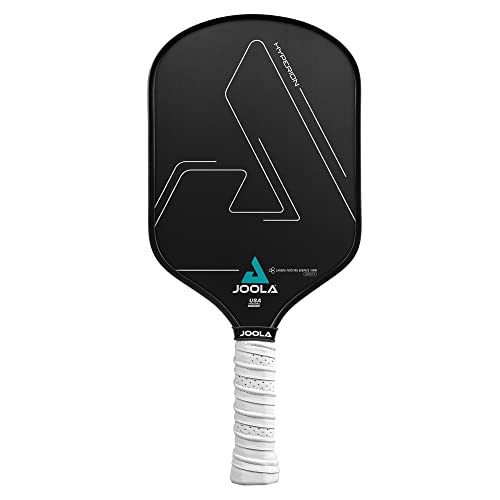
JOOLA Ben Johns Hyperion CFS 16mm
The paddle that Ben Johns helped develop for all-court play. A carbon fiber surface generates reliable spin while the 16mm core balances soft-game control with enough power for attacking fourth shots. Elongated shape favors players with a tennis background.
pickleball paddles
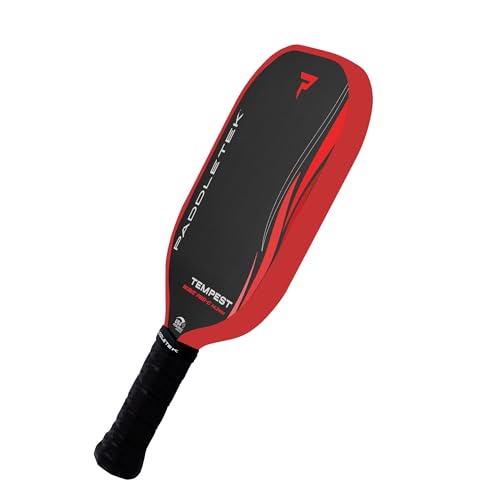
Paddletek Tempest Wave Pro-C
A USA-manufactured 14.3mm carbon fiber paddle built around Paddletek's Smart Response Technology polymer core. Weighing 7.6 to 8.0 oz, the Tempest Wave Pro-C is the control-focused choice in the Paddletek lineup, favored by players who prioritize placement over pace.

pickleball paddles
Franklin Signature Series Pro
A carbon fiber paddle from Franklin built around a 16mm polymer honeycomb core. The Signature Pro is Franklin's performance-tier offering for the improving recreational player who wants professional-grade construction at an accessible price.

pickleball paddles
CRBN 2X 16mm Power Series
A 16mm thermoformed carbon fiber paddle with injected foam edge walls, an 8-inch-wide face for an expanded sweet spot, and CRBN's TruFoam construction. The 2X is the wider-body version of CRBN's power line and the brand's most forgiving model for intermediate players.
What foam cores actually do differently
The key claim for full foam cores is that they eliminate core crush, which is the structural degradation that happens to polymer honeycomb over time as repeated impacts compress the cells and make the core progressively softer. A crushed honeycomb core loses its original feel characteristics, often becoming deader and more inconsistent. Foam cores do not have cell walls to crush the same way, which means the core theoretically maintains its feel longer.
Foam cores also distribute energy differently across the face. A honeycomb core has structural variations based on where the honeycomb cells are relative to the contact point. A uniform foam core provides more consistent energy distribution, which can translate to a more uniform sweet spot across the full hitting surface. Some players report that full foam paddles feel more consistent from the edge of the face inward.
The power claim for foam cores requires some nuance. Foam is not inherently more powerful than honeycomb at the same thickness. What foam allows is more design flexibility: core density can be tuned more precisely than honeycomb cell geometry. A dense foam core can produce more ball speed than an equivalent honeycomb at the same thickness. However, some early foam-core paddles were also criticized for producing too much power and trampoline effect, which fed into USAP PBCoR testing concerns.
The USAP and PBCoR context for Gen 4 paddles
USA Pickleball introduced the PBCoR (Paddle/Ball Coefficient of Restitution) testing standard in late 2024, with enforcement beginning July 1, 2025. PBCoR measures how much energy a paddle returns to the ball on contact, specifically targeting the 'trampoline effect' where a paddle face flexes and snaps back to amplify ball speed beyond what the swing generates. Several paddles were removed from the USAP approved list when they failed PBCoR testing.
Some early thermoformed and foam-core paddles were flagged in this process because their design produced higher-than-allowed energy return. This does not mean all foam-core paddles are problematic; it means early versions pushed the limits and USAP responded with a formal test. Current Gen 4 paddles from established brands are tested against PBCoR before going to market, and brands have adjusted foam density and construction to pass certification.
Before buying a Gen 4 foam-core paddle for sanctioned tournament play, verify the specific model at the official USAP equipment verification site at equipment.usapickleball.org. Check by model name, not just brand, as individual models can have different approval status even within the same product line. For recreational open play without USAP rules, approval status does not matter, but it is worth knowing.
Who should consider upgrading to Gen 4 and who should not
Gen 4 foam-core paddles make the most sense for players at 3.5 and above who have already spent time with a quality thermoformed paddle and can feel the difference in core performance between sessions. If you have noticed your current paddle losing its original feel after 6 to 12 months of regular play, core crush is a real possibility, and foam core's durability advantage is a legitimate reason to try the technology.
Players who drill frequently, play multiple sessions per day, or use a single paddle for tournament travel are the profiles where foam core durability compounds into real value. The higher initial cost of Gen 4 paddles is easier to justify when the comparison is lasting two years rather than one before the core softens.
Who should not rush to upgrade: players below 3.0 who are still developing fundamental contact and footwork, players who are happy with their current paddle's feel and have no specific complaint, and players on a budget. Gen 4 paddles are currently priced at $180 and above. The Selkirk LUXX Control Air S2 at $180 to $200 with its thick polymer honeycomb core remains excellent for kitchen-dominant players, and the CRBN 2X 16mm Power Series with its TruFoam foam-injected edge construction offers a meaningful step toward foam technology at a lower entry point than full Gen 4 products.

pickleball paddles
Selkirk LUXX Control Air S2
A 20mm Thikset honeycomb core paired with a Florek Blended Carbon Fiber face produces one of the softest, most responsive dinking experiences on the market. At 8.1 to 8.5 oz and with a 4.5-inch handle, it is built for kitchen-dominant players who value touch over raw power.
pickleball paddles
CRBN 2X 16mm Power Series
A 16mm thermoformed carbon fiber paddle with injected foam edge walls, an 8-inch-wide face for an expanded sweet spot, and CRBN's TruFoam construction. The 2X is the wider-body version of CRBN's power line and the brand's most forgiving model for intermediate players.
What to watch for as the Gen 4 market develops
The foam core category is still maturing. Early models from 2024 and 2025 showed both promise and inconsistency as brands refined foam density and bonding techniques. By mid-2026, the best Gen 4 paddles are meaningfully better than the first releases, but the category does not yet have the years of real-world player feedback that conventional thermoformed paddles have accumulated.
The most honest advice: if you are at 4.0 and above, demo a Gen 4 paddle before buying. Many retailers and paddle clubs offer demo programs. The feel difference from a conventional thermoformed paddle is real, but whether it suits your specific game style is not predictable from specs alone. Power players who rely on aggressive driving may prefer the energy efficiency of a well-tuned honeycomb core. Control players who live at the kitchen may find that certain foam builds feel too lively.
Watch for USAP approval status updates as new models release. Check equipment.usapickleball.org regularly if you play sanctioned leagues or tournaments, since approval status can change after a model is on the market. Established brands with tournament infrastructure, like Selkirk, JOOLA, and CRBN, have strong incentives to maintain USAP certification and tend to be more reliable on this front than smaller newer entrants.
pickleball paddles
JOOLA Ben Johns Hyperion CFS 16mm
The paddle that Ben Johns helped develop for all-court play. A carbon fiber surface generates reliable spin while the 16mm core balances soft-game control with enough power for attacking fourth shots. Elongated shape favors players with a tennis background.
pickleball paddles
Selkirk Vanguard Power Air Invikta
The elongated model in Selkirk's Vanguard Power Air series. A Raw T700 carbon fiber face with Air Dynamic Throat construction reduces swing weight while maintaining the extended reach and leverage of the Invikta platform. Built for advanced kitchen players who want both touch and power.
pickleball paddles
CRBN 2X 16mm Power Series
A 16mm thermoformed carbon fiber paddle with injected foam edge walls, an 8-inch-wide face for an expanded sweet spot, and CRBN's TruFoam construction. The 2X is the wider-body version of CRBN's power line and the brand's most forgiving model for intermediate players.
pickleball paddles
Selkirk LUXX Control Air S2
A 20mm Thikset honeycomb core paired with a Florek Blended Carbon Fiber face produces one of the softest, most responsive dinking experiences on the market. At 8.1 to 8.5 oz and with a 4.5-inch handle, it is built for kitchen-dominant players who value touch over raw power.
pickleball paddles
JOOLA Ben Johns Hyperion CFS 16mm
The paddle that Ben Johns helped develop for all-court play. A carbon fiber surface generates reliable spin while the 16mm core balances soft-game control with enough power for attacking fourth shots. Elongated shape favors players with a tennis background.

pickleball paddles
JOOLA Ben Johns Perseus Pro IV
The advanced-player version of the Ben Johns lineup, with an elongated 16.5-inch platform, carbon fiber face, and a power-forward feel built for attacking play. Used at the 5.0 and professional levels where aggressive fourth shots and drives define the game.
pickleball paddles
Paddletek Tempest Wave Pro-C
A USA-manufactured 14.3mm carbon fiber paddle built around Paddletek's Smart Response Technology polymer core. Weighing 7.6 to 8.0 oz, the Tempest Wave Pro-C is the control-focused choice in the Paddletek lineup, favored by players who prioritize placement over pace.
FAQ
Frequently asked questions
Are Gen 4 foam-core paddles approved by USAP?+
Some are and some are not, and approval status changes as new models are tested. The label 'Gen 4' does not tell you anything about USAP approval; you have to check the specific model name on the official USAP equipment verification page at equipment.usapickleball.org. For recreational open play without USAP rules, approval status is irrelevant. For sanctioned tournaments and many local leagues, verify before you commit to a paddle.
What is the main practical difference between Gen 3 and Gen 4?+
Gen 3 paddles use thermoformed construction with polymer honeycomb cores, often with foam-injected edges. Gen 4 replaces the entire honeycomb core with foam, which changes how energy is distributed across the face and, in theory, reduces the core crush that makes honeycomb paddles lose their feel over time. The difference in play feel is real but not always dramatic, and is most noticeable in sweet spot consistency and long-term durability.
Is core crush a real problem or just marketing?+
It is a real phenomenon in polymer honeycomb cores, particularly in players who play frequently and hard. Repeated high-impact contacts gradually compress the honeycomb cell walls, making the core softer over time. The result is that the paddle plays differently than it did when new: often deader, with a different sound and less consistent response. Players who rotate paddles, play fewer hours per week, or use their equipment gently may never notice it. Players who drill daily and play tournaments regularly often do.